by admin | Jun 24, 2026 | Completed Granny Flats, Granny Flats, Investment, Lake Macquarie, The Prime, Two Bed Granny Flats
Two-Bedroom Prime Granny Flat Built in Wallsend, Lake Macquarie
For Deb and Greg, the goal was simple: make their Wallsend property work harder. They had the land, they had the vision, and a granny flat made sense as a long-term investment rather than letting the backyard sit idle. Wallsend sits on the edge of Lake Macquarie, close to major shopping hubs and within easy reach of the lake foreshore, and that kind of location attracts solid rental demand. Aplus Granny Flats was brought in to build something that would appeal to quality tenants and deliver reliable returns from day one.
The Right Design
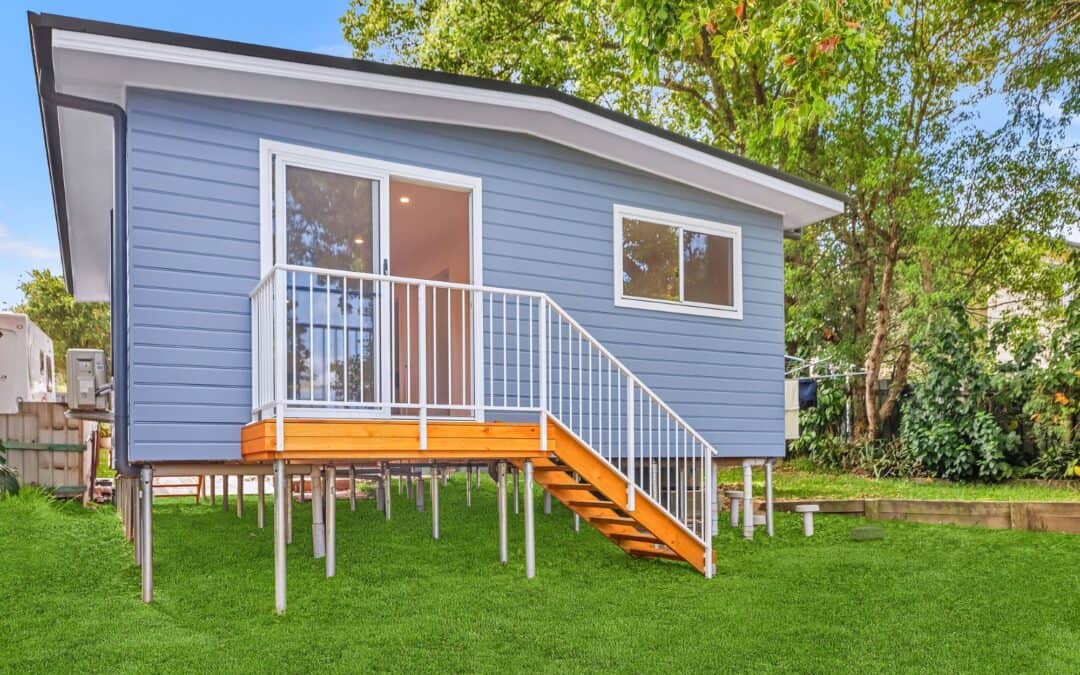
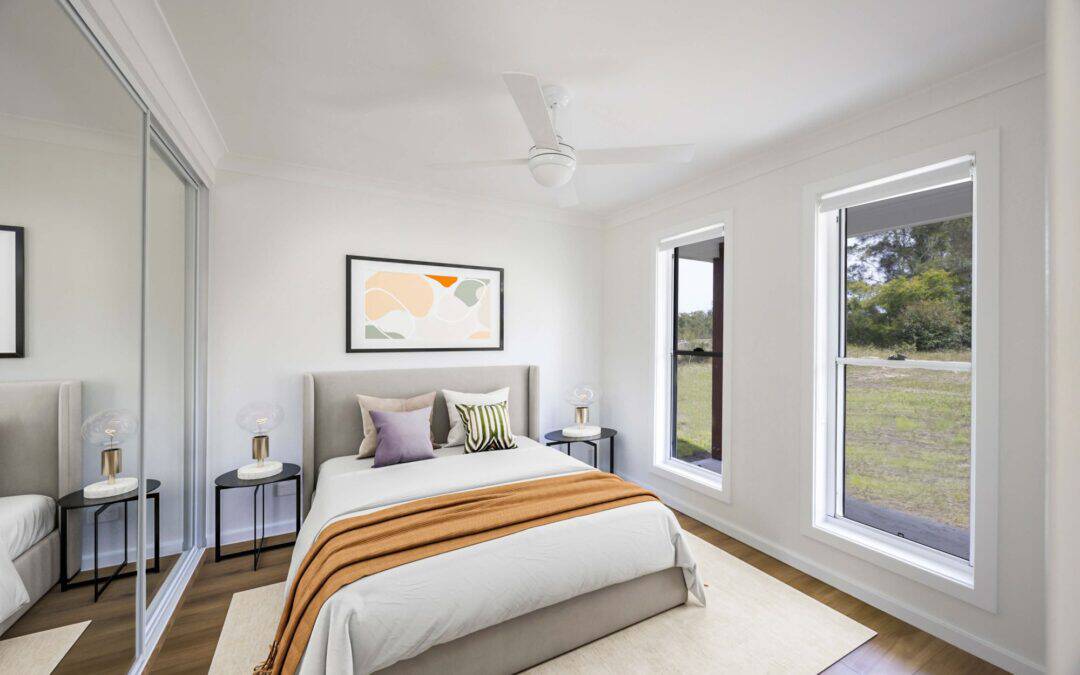
Deb and Greg chose The Prime, a two-bedroom design from the Aplus two-bedroom granny flat range built around efficiency and liveability. The layout delivers two bedrooms with built-in wardrobes, an open-plan kitchen, living and dining area, plus a bathroom and laundry, all in a compact, contemporary footprint. For a rental property the design makes strong practical sense: it is easy to maintain, easy to let, and the open-plan living zone creates a feeling of space that presents well to prospective tenants. One variation from the standard specification was swapping the entrance door for a sliding glass door, which draws more light into the living area and gives the flat a polished, modern feel from the moment you walk in.
Construction and Site
The flat is built on a bearers-and-joists (B&J) floor system, with the structure raised on screw piers that were specified by the project engineer to suit the ground conditions on the Wallsend site. Screw piers are driven directly into the ground rather than relying on poured concrete footings, making them a precise engineering solution for sites where soil conditions call for it. Because the B&J floor system raises the structure a good distance above ground level, scaffolding was required during the build so the trades could work safely at height. The space created beneath the flat also provides useful under-home storage, which is a practical bonus for tenants.
A 4,000-litre rainwater tank was installed as required by the National Construction Code (NCC). The tank is plumbed into the property as part of the standard service connections. At colour selection, Deb and Greg kept things simple and stayed with the standard inclusions throughout. For an investment property, that is often the right call: clean, neutral finishes are easy to rent and straightforward to maintain over the long term.
Approval and Build
The project was approved through a Complying Development Certificate (CDC), the fast-track pathway that uses a private certifier rather than going through full council assessment. For a well-suited investment build like this one, CDC was the right fit: it is quicker than a Development Application (DA) and the result is the same quality build at the end. Construction was completed in 2023, with the project running smoothly from start to handover.
The Result
The flat was leased quickly and has been returning $480 a week in rent, delivering Deb and Greg a gross annual rental income of around $24,960. The property was listed as a brand-new home with filtered bushland views of Lake Macquarie, featuring an air-conditioned open-plan living area, a covered entertainer’s deck, and under-home storage. For a two-bedroom, one-bathroom investment property in Wallsend, that is a strong package. The flat is doing exactly what Deb and Greg built it to do.
Granny Flat Investment in Wallsend and Lake Macquarie
Wallsend sits on the northern edge of Lake Macquarie, well positioned between the Newcastle CBD and the lake foreshore at Warners Bay. It is a suburb with strong rental demand and the kind of steady population that makes a granny flat investment a reliable long-term proposition. Aplus builds regularly across the Lake Macquarie region, including other completed projects like this two-bedroom, two-bathroom build in Lake Macquarie. If you are thinking about a granny flat in Wallsend or anywhere across the Lake Macquarie area, Aplus can guide you through every step of the process.
Thinking about a granny flat investment in Wallsend or the wider Lake Macquarie area? Aplus Granny Flats builds across NSW. Get in touch for a free quote.
by Granny Flat Builder | Jun 24, 2026 | Completed Granny Flats, Granny Flat with Garage, Granny Flats, Investment, Mid Coast, The Summit, Two Bed Granny Flats
A Practical Investment: Granny Flat Over Garage in Mid Coast
This project in Blackhead, within the Mid Coast Council area, was designed as a smart, long-term investment—making better use of the existing block while working in with the established home.
Starting with The Summit, one of our two-bedroom, two-storey granny flat designs, the client used the proven floor plan as a foundation. From there, the design was tailored to suit the site, budget, and local context.
This was an owner-occupied build, delivered in a 17-week construction period, demonstrating how an efficient, well-planned two-storey granny flat can be delivered within a defined timeframe.
Building in the Mid Coast Council Area
Building a granny flat in the Mid Coast region—whether in Blackhead, Forster, Taree or surrounding areas—requires an understanding of local conditions, council requirements, and site constraints. Many blocks in this region benefit from a more considered approach due to:
- Sloping land or varied site levels
- Coastal conditions and exposure
- Established homes that new builds need to complement
- The need to maximise usable space without overbuilding the site
Two-storey granny flats are often a practical solution in these areas, allowing you to work with the land rather than against it—and in coastal locations, potentially capturing outlook or breeze.
For this project, coastal proximity also influenced material selection, including marine-grade roofing, window frames, flyscreens and garage door to ensure long-term durability in a salt-exposed environment
Why Build a Granny Flat Over a Garage?
A design like this—garage below with living space above—offers a number of practical and financial advantages:
- Preserves backyard space by building upward
- Provides secure parking or storage at ground level
- Works well on tighter or irregular blocks
- Creates a more flexible investment, suitable for rental or extended family
For this Blackhead project, the outcome is a compact footprint with a highly functional layout, designed for long-term owner use.
Starting with The Summit Floor Plan
Rather than designing from scratch, this project began with The Summit—a well-resolved two-storey granny flat layout. From there, we customised the design to better suit the client’s priorities and how they intended to use the space.
Key changes included:
- Converting the design to a larger one-bedroom layout with expanded living and dining
- Adding an internal access staircase from the garage
- Including a ground floor WC and rear external garage door for practicality
- Removing the balcony to align with budget and simplify construction
- Selecting finishes to better match the existing home, including a feature entrance door in Dulux Redbox
This approach allows clients to start with a proven layout, while still achieving a tailored, site-specific outcome.
Understanding the Cost of a Two-Storey Granny Flat
Builds based on The Summit typically start from around $350,000. While the upper-level living area is approximately 60m², the cost reflects the additional complexity involved in a two-storey structure.
For this project, the total design, approvals and construction cost came to $347,728.50 (inc. GST).
Compared to a standard single-storey granny flat, this includes:
- More advanced engineering and structural design
- Additional materials and support systems
- A more detailed construction process
When building over a garage, you’re creating a fully integrated structure—not just a standalone dwelling—which is why the investment is higher.
Two-Storey Granny Flat Over Garage – Gallery
A Custom Outcome, Not a Standard Build
Although this project started with a standard design, the finished result is entirely site-specific. The simplified exterior, practical layout, and integration with the existing home ensure the granny flat feels like a natural extension of the property—not an afterthought.
The combination of coastal-ready materials, layout adjustments, and functional inclusions reflects how even a “standard” design evolves significantly during the build process.
This is how we approach every project:
- Start with a proven design
- Adapt it to suit your site, lifestyle and budget
- Deliver a result that fits both the property and the region
Building Granny Flats Across the Mid Coast
We work across the Mid Coast Council area, delivering granny flats designed to suit local conditions—from coastal sites like Blackhead through to larger regional blocks.
If you’re considering a granny flat over a garage or exploring two-storey granny flat options in the Mid Coast, the process starts with a floor plan that works—then evolves into a design tailored to your site.
by admin | Jun 24, 2026 | Granny Flats, Investment
Why the 2026 Budget Changes Are Actually Great News for NSW Granny Flat Builders
Last night’s Federal Budget dropped a bombshell on Australian property investors. Changes to negative gearing and capital gains tax will reshape the investment landscape from 1 July 2027. The headlines are full of warnings, property investor forums are buzzing, and plenty of landlords are feeling uncertain.
But if you’re a NSW homeowner thinking about building a granny flat on your existing property? The picture looks very different — and quite a bit brighter than you might expect.
Here’s why.
First, What Actually Changed?
The Albanese government announced two major property tax reforms in the 2026-27 Budget:
Negative gearing changes (from 1 July 2027): Losses on new residential investment properties can only be deducted against other property income — not against your wage or salary. Properties already owned before Budget night (12 May 2026) are grandfathered and unaffected.
Capital gains tax changes (from 1 July 2027): The existing 50% CGT discount is replaced with CPI indexation of the cost base plus a 30% minimum tax on real gains. In plain English: you’ll only be taxed on the portion of your gain that genuinely exceeded inflation.
These changes matter — a lot — for investors who rely on negative gearing to make their numbers work. But granny flat owners? They typically don’t rely on negative gearing at all. And that’s exactly the point.
Granny Flats Are Built to Be Cash-Positive
The entire investment case for a granny flat rests on positive cash flow, not tax losses.
In NSW, a well-built granny flat commands $450 to $700 per week in rent depending on location, size, and finish. That’s $23,000 to $36,000 per year in additional household income. The total cost to build — including DA or CDC approval, site preparation, and construction — typically ranges from $195,000 to $295,000 for a quality two-bedroom dwelling.
Run the numbers and most granny flats reach positive gearing within the first year or two. The rent exceeds the loan repayments, maintenance costs, and any associated expenses. There’s no need to claim a loss against your wages because — unlike a typical investment property purchase — you’re not running at a loss.
Negative gearing has always been irrelevant to the granny flat investment model. The Budget changes don’t take away something granny flat owners were ever counting on.
Your Existing Land Is the Biggest Advantage You Have
One of the quieter reasons the Budget changes actually favour granny flat builders is what you don’t have to do.
Buying a new investment property in 2026 means stamp duty, a new mortgage, legal fees, and a lengthy settlement process — all before you’ve collected a single dollar in rent. And from 1 July 2027, if that new property runs at a loss, you can only offset it against other property income, not your salary.
When you build a granny flat on your existing land, none of that applies. You’re using an asset you already own. There’s no stamp duty. No new mortgage required (many owners finance the build through equity or construction loans secured against the existing property). And you’re adding a separate income-producing dwelling to land you already hold.
The tax changes don’t touch any of this. Your existing property is grandfathered. The construction of the granny flat itself increases the cost base of your property, which directly benefits you under the new CGT rules.
How the New CGT Rules Actually Favour Long-Term NSW Owners
Under the new capital gains tax arrangements, gains are indexed to CPI. This means you’re only taxed on your real gain — the amount your property genuinely increased in value above inflation.
For a NSW homeowner who adds a quality granny flat to their property, this works in your favour in two ways:
First, the construction cost increases your cost base. The money you spend building the granny flat is added to the cost base of your property. If you spend $220,000 building a granny flat, that $220,000 reduces the taxable capital gain when you eventually sell.
Second, the property is likely worth more than you spent. A quality granny flat in a well-located Sydney suburb or coastal NSW town typically adds more value to a property than it costs to build. Research by CoreLogic has found that adding a granny flat can increase a property’s value by 20 to 30% — meaning the equity uplift often substantially exceeds the cost of construction. A $220,000 build that adds $300,000 or more to a well-located property’s market value is a strong equity play. Under the new CPI indexation rules, only the real gain above inflation is taxed, making genuine value-adding improvements like this even more attractive.
The Budget’s changes to CGT actually reward genuine capital investment. Adding a dwelling that increases housing supply and generates real value is precisely what the government is trying to encourage.
NSW Rental Demand Has Never Been Higher
The policy context behind these Budget changes matters for granny flat owners. The government explicitly designed these reforms to encourage new housing supply and reduce investor speculation in established properties. Their own modelling projects that the changes will support 75,000 additional homeowners over the next decade.
Meanwhile, the rental vacancy rate across Greater Sydney and regional NSW remains at historic lows. The shortage of affordable rental accommodation — particularly separate, private dwellings — continues to push rents higher. A granny flat on a well-located block is not a speculative bet. It’s a direct response to a documented shortage.
Tenants actively seek out quality granny flats because they offer privacy, their own outdoor space, and typically lower rents than a full standalone house. The demand is there. The market is not going away.
What This Means If You’re Considering Building Now
If you own your NSW property already: You are fully grandfathered from the negative gearing changes. Your property’s tax treatment is locked in under the current rules. Building a granny flat on your land takes advantage of the equity and site you already hold, generates immediate rental income, and increases your cost base for CGT purposes — all without triggering any of the Budget’s new restrictions.
If you’re planning to buy a NSW property to build on: The tax treatment of properties purchased after Budget night will depend on your individual circumstances and timing — speak to your accountant about what applies to you. What remains true regardless: granny flats are typically positively geared from the outset, which means the negative gearing changes are far less relevant to a granny flat strategy than to a conventional investment property purchase.
In either case: The fundamentals that make granny flats attractive have not changed. Strong NSW rental income, low vacancy rates, capital value uplift, and the ability to add a dwelling to land you already own remain as compelling as they’ve ever been.
The Bottom Line
The 2026 Budget is bad news for property investors who rely on paper losses to reduce their tax bill. It is not bad news for NSW homeowners who want to build a granny flat, generate genuine rental income, and increase the value of the property they already live on.
Granny flats were always a different kind of investment — one built on real cash returns, not tax-minimisation strategies. In the new tax environment, that approach looks smarter than ever.
If you’d like to understand exactly what a granny flat could mean for your property — in terms of rental income, construction cost, approval pathway, and long-term capital value — speak to the team at A Plus Granny Flats. We’ve been building quality secondary dwellings across NSW for years, and we know how to make the numbers work for your specific site and situation.
Get a free assessment of your property →
Or browse the full two-bedroom granny flat design range to find the right fit for your property.
This article is general in nature and does not constitute financial or tax advice. We recommend speaking with a qualified accountant or financial adviser about your individual circumstances before making any investment decisions.