by Granny Flat Builder | Jun 24, 2026 | Granny Flats
Are you yearning for a little extra living space, or a way to expand an investment but think your property is too small to accommodate it? Think again! The notion that a Granny Flat can’t find its place on a property with less than 450m² is a misconception. The truth is, with the right planning team and a thorough understanding of the regulations, you can indeed add a secondary dwelling to your smaller lot. Read this article and note the council areas that allow this via their Local Environmental Planning (LEP) guidelines, and talk to Aplus about building a Granny Flat on your less than 450m2 block, today.
Unraveling the Regulations for Blocks Less Than 450m2
Before you dive headfirst into your Granny Flat project, it’s important to comprehend the regulatory landscape. There are distinct avenues through which you can seek approval for your secondary dwelling:
1. Complying Development Certificate (CDC)
A secondary dwelling can be approved by lodging a complying development application with Council or a Private Certifier. This is the most preferred way of obtaining approval to build a secondary dwelling as it is the quickest and usually the most straight forward. To receive a CDC, you must comply with the requirements in the in the State Environmental Planning Policy (SEPP) (Housing) 2021. In the SEPP, a minimum lot size of 450m2 and a minimum lot width of 12m is required. A secondary dwelling approved as complying development must also be on land zoned R1, R2, R3 or R4.
2. Development Application (DA) using the SEPP (Housing) 2021
A secondary dwelling may also be approved with a DA using the SEPP (Housing) 2021 and as with all Development Applications in NSW, it must be approved by the Local Council. This application would require the lot size to be a minimum of 450m2. The possible reasons for lodging a DA using the SEPP (Housing) 2021 rather than applying for a CDC may be, the lot is zoned R5, the lot is located within a heritage conservation area or the land is affected by high risk or high hazard flooding. There are other reasons a CDC may not be appropriate and a DA using the SEPP (Housing) 2021 is a better alternative.
3. Development Application (DA) using the Local Environmental Plan (LEP)
Each Local Council has its own LEP and each LEP has different development requirements that need to be addressed when lodging a DA this way. This approval pathway is how we may be able to build a secondary dwelling on a lot less than 450m2.
Which NSW Councils Allow Granny Flats on Less than 450m2 Blocks?
Below is a list of Local Councils that either support or do not support a secondary dwelling on a lot size less than 450m2. If you do not see the Council you need, please contact the Planning Department for more information. *Please note information is up to date September 2023, but subject to change. If in doubt, request a Site Assessment and we’ll be armed with all the information you need.
| Less than 450m2 allowable* | 450m2 or more required |
| Bayside | Blacktown (500m2 min attached, 600m2 min detached) |
| Blue Mountains | Fairfield |
| Camden | Lake Macquarie |
| Campbelltown | Penrith |
| Central Coast | |
| Cessnock | |
| Eurobodalla | |
| Ku-ring-gai | |
| Lithgow | |
| Maitland | |
| Muswellbrook | |
| Newcastle | |
| Port Stephens | |
| Queanbeyan-Palerang | |
| Shellharbour | |
| Sutherland | |
| Upper Hunter | |
| Wollondilly | |
| Wollongong |
Can You Build a Granny Flat on Your Block?
Beyond the Minimum Lot Size
While the minimum lot size requirement might seem like a roadblock, it’s crucial to recognise that regulations aren’t set in stone. Local Councils have the power to grant exceptions and exercise discretion based on various factors. Demonstrating the compatibility of your proposed Granny Flat with the neighborhood, highlighting smart design that maximizes space, and addressing any concerns raised by the Council can all contribute to a successful approval process.
Unlocking Your Property’s Potential
The takeaway here is that your property’s size doesn’t have to limit your aspirations for extra living space. With a thorough grasp of the regulations and a strategic approach, you can create a harmonious coexistence between your secondary dwelling and your smaller lot. Whether it’s through a CDC, a tailored DA under SEPP (Housing) 2021, or a well-aligned DA under the Local Environmental Plan, your dream of a granny flat is within reach – yes, even on a lot smaller than 450m²!
Knowledge is non-negotiable. Our Design Consultant will measure out your site and help you fully understand the possibilities for your block, and be able to discuss in detail your options for a CDC or Development Application. When you’re planning to build, you want assurance that your site is suitable, and that you are not going to be impacted mid-build by unforeseen or surprise costs. We provide a thorough, free, upfront feasibility study for your Granny Flat which gives you an assured green light to build.
by Granny Flat Builder | Jun 24, 2026 | Central Coast, Completed Granny Flats, Granny Flat with Garage, Granny Flats, The Zenith, Two Bed Granny Flats
Granny Flat with Carport in Umina: A Smart Investment for Long-Term Rental Returns
When Vanessa and Hamish began planning improvements for their investment property in Umina, they were clear on one thing: parking matters. In a suburb where rental demand is strong and tenants value practical inclusions, the ability to offer a dedicated carport would position their new granny flat as a premium rental option.
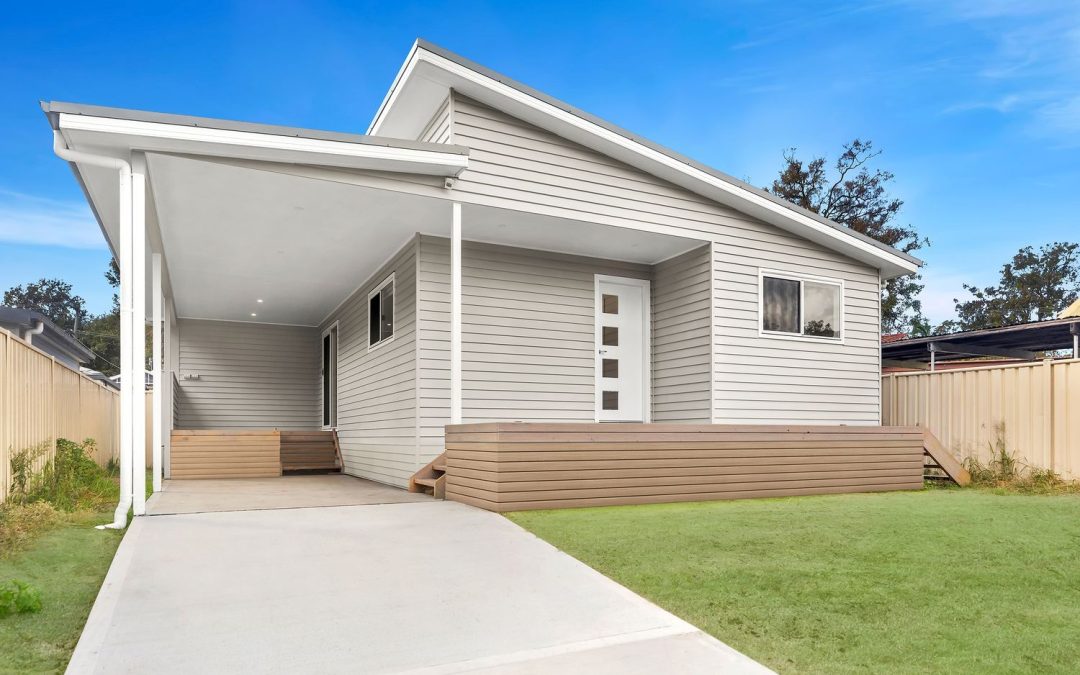
They chose The Dock, modified to suit both the shape of the block and their investment strategy, and partnered with the Aplus team to deliver a high-amenity granny flat with generous outdoor living, a sleek skillion roofline, and a secure carport that adds both value and tenant appeal.
Meeting the Brief: Practical, Modern, Rental-Focused
Umina is a beachside suburb known for its strong rental yields and steady demand from singles, couples, downsizers, and essential workers. Vanessa and Hamish knew that adding a secondary dwelling was the right move, but they also understood the difference between just adding a granny flat and adding one that attracts higher-quality tenants for longer periods.
Parking was a priority. Outdoor living mattered too. And the home needed to feel modern, bright, and welcoming.
Working under a Complying Development Certificate (CDC), Aplus delivered a faster approval pathway—meaning the investors could move from concept to construction without council delays.
A Design Tailored to the Block, and to Tenant Needs
The modified version of The Dock was an immediate match for the block. Compact yet spacious, and with clever opportunities for expansion, it allowed several additions to maximise the liveability of the granny flat:
Key structural inclusions within the quote:
- Extended front porch and decking, creating a welcoming entry
- Addition of an alfresco deck—ideal for the Umina lifestyle
- Cladding applied to the rear wall and dwarf wall to deck
- Carport with Colorbond roofing providing valuable covered parking
- Breakfast bar added to the kitchen for extra functionality
- A glass sliding door opening to the deck
- Skillion roof with raked ceiling to the living area
- Hi-lite windows to maximise natural light and coastal airflow
These enhancements created a light-filled interior and strong connection to outdoor living; features that consistently appeal to tenants on the Central Coast.
Interior Selections That Lift the Entire Space
During colour and product selections, Vanessa and Hamish opted for several upgrades to improve the tenant experience and future-proof the investment:
- Upgraded entrance door for stronger street appeal
- Stylish kitchen splashback
- Contemporary cabinetry handles
- PC item upgrades
- Added a dishwasher
- Added a shower niche for storage
- Microwave provision to free up bench space
These small but impactful upgrades ensure the granny flat feels more like a modern home than a basic secondary dwelling; another important differentiator in the Umina rental market.
On-Site Additions: Finishing Touches That Add Value
Once construction was underway, the clients added a concrete driveway, integrating the carport seamlessly into the overall layout. The combination of driveway + carport makes day-to-day access effortless, increases property value, and elevates tenant appeal.
The finished result is a tidy, functional, coastal-influenced granny flat with strong rental potential – exactly what savvy investors in Umina look for.
Granny Flat with Carport in Umina Photo Gallery
Why a Granny Flat with Carport Works So Well in Umina
Umina’s popularity continues to rise with renters who value:
- quick access to beaches
- proximity to Woy Woy station
- quality schooling options
- local shopping and dining
- close connection to major employment hubs
And while granny flats already perform exceptionally well in this region, adding a carport or dedicated parking pushes the property further into the “high-demand” category.
Tenants are willing to pay more for secure parking, weather protection, and clear access, particularly in suburbs like Umina where many older homes lack modern parking infrastructure.
If you’re considering a similar project, designs such as The Dock, The Prime, The Zenith, and The Summit can all be adapted to include a carport, garage, or driveway depending on the shape of your block.
Explore our full granny flat design range to see which layout suits your property.
Built by Local Experts Who Understand the Central Coast
From the initial inspection to the handover, our team worked closely with Vanessa and Hamish to deliver a granny flat that met their investment goals and maximised every square metre of the site.
At Aplus Granny Flats, we’ve completed hundreds of secondary dwellings across the Central Coast, each built to meet local requirements, flood considerations, market rental expectations, and the unique features of individual blocks.
If you’re planning a granny flat in Umina, Ettalong, Woy Woy, or anywhere across the Central Coast, our team can help you design a practical, profitable solution, whether you need a carport, garage, or simple driveway access.
View more completed projects or book your free site assessment to get started. Explore Aplus Granny Flat designs to see how your vision can come to life.
by Granny Flat Builder | Jun 24, 2026 | Granny Flats
Exploring the Distinctions Between a Granny Flat and a Studio: Which Suits You Best? Navigating the realm of housing terminologies can be quite confusing, especially when it comes to distinguishing between seemingly similar concepts like ‘Is it a Granny Flat or a studio?’. However, failing to grasp the differences could potentially lead to unforeseen challenges down the road, especially with regard to marketing your property for sale – and the value that a Granny Flat or studio will set. In the realm of council planning, comprehending these distinctions is crucial, as each term carries unique implications that can significantly impact your living arrangements, lifestyle and the value of your home. Let’s delve into the definitions and contrasts between these two housing options to unravel their intricacies.
Decoding ‘Studio’ in Council Planning Terms?
Within the realm of council planning, a ‘studio’ is not explicitly outlined in the legislation, but it generally refers to an accessory structure, or an ‘extra room’, that serves a specific purpose. Studios are typically adjunct to an existing dwelling, utilised for specific functions like art studios, home offices, or even occasional guest bedrooms. However, what sets them apart is that while they can accommodate some living amenities, they can’t legally be classified as separate dwellings. This also means you legally cannot rent these out as a separate dwelling.
What is a Granny Flat?
Granny Flats, is officially known as a secondary dwelling, is formally recognised and allowed for in planning legislation and, when built to specific standards, is recognised as a fully independent habitation units, distinct from the primary residence.
These secondary dwellings can stand on their own, offering self-contained living spaces with all necessary amenities for separate occupation. While there is often a cap on their size, 60 square meters in NSW and 90m2 in ACT, exceptions may exist in specific regions, allowing for larger configurations.
A Granny Flat, that is an officially recognised secondary dwelling is legally able to be rented out and earn income.
How to delineate between a Granny Flat or a Studio?
In essence, the line between a Granny Flat and a studio lies in the level of autonomy and intended use. A Granny Flat, or secondary dwelling, represents a self-sufficient abode that must specifically encompass a separate kitchen, making it suitable for year-round occupancy.
On the other hand, a studio remains tethered to its parent dwelling and serves as a space for specialised activities like artistry or crafting. While it can include certain living provisions such as a bathroom and even a sleeping area, it lacks the facilities to prepare meals, wash clothes, thus precluding it from being considered a separate, permanent dwelling. This crucial distinction is also upheld in the National Construction Code.
How to select a path forward – a Granny Flat or studio?
With Channel 9’s The Block confirming the desirability of studio and Granny Flat spaces whichever you choose will add value to your home. If you just require a separate living and sleeping area with a private bathroom and no kitchen facilities, and you do not require a full kitchen and laundry – a studio-style extension could be just what your home needs. This sort of ground floor extension or ‘pod’ starts at $150,000. Contact Aplus to find out exactly what is possible at your place, the sooner you start the process of working out what is possible – the sooner you will get approved and get ready to create this special new space for your family.
by Granny Flat Builder | Jun 24, 2026 | Granny Flats
Have you always wanted to enjoy the financial benefits and lifestyle advantages of a Granny Flat on your property, but have limited backyard space? Attached Granny Flats (sometimes referred to as a dual living design) are a great option for accommodating older children, extended family, guests, renters, live in nannies and, of course, grandparents!
In this article, we unpack a few key facts about what exactly qualifies as an attached Granny Flat, and why they are such an attractive option.
What is the definition of an Attached Granny Flat?
According to the Affordable Rental Housing State Environmental Planning Policy (NSW) 2009, a Granny Flat or secondary dwelling is referred to as a self-contained dwelling that is erected on a property in conjunction with another dwelling (the principal dwelling), and can be either attached to or detached from the principal dwelling.
A granny flat is considered ‘attached’ once it is within 900mm from the principal dwelling.
What are the benefits of an Attached Granny Flat?
For both savvy investors and family-oriented homeowners, Attached Granny Flats bring a wide range of benefits:
- An Attached Granny Flat can work well for smaller blocks of land such as homeowners who live closer to the city, or for those who want to keep as much of their garden space as possible.
- They provide that added level of security, supervision and closeness, for accommodating family members that are ageing, have a disability, or just generally need a little extra support.
- Preserve your privacy while comfortably hosting guests or relatives, and reap the benefits of built-in babysitters!
- It provides functional, versatile space that can even be used as a home office, allowing remote workers to join video conferences in a peaceful, professional and private manner. Plus, every Attached Granny Flat built by Aplus includes the very latest in Wi-Fi technology as standard.
- Aplus Attached Granny Flats can be completely customised to suit your needs and tastes. For example, you can add wheelchair ramps and wider doorframes, extended outdoor decking and alfresco areas, or you can even design your Granny Flat to match the look and feel of your existing property.
- Add substantial value to your existing property, and establish a regular form of passive income if you choose to lease the Attached Granny Flat. In today’s agile world, there are also more casual income opportunities at your disposal such as short-term Airbnb renting.
Are there any rules about what an Attached Granny Flat can and cannot include?
The Nation Construction Code (NCC) requires all Granny Flats to include a kitchen, a bath or shower, clothes washing facilities and a toilet. Another important requirement to help stop the spread of fire from one dwelling to another is a wall with an FRL (Fire Resistance Level) of not less than 60/60/60, or a masonry wall not less than 90mm thick, between the Granny Flat and principal dwelling
It is also preferred that there is no internal access between the Granny Flat and principal dwelling. If a door is provided, it would be need to be a self-closing door with solid core and a thickness of no less than 35mm.
Are there any advantages to building an Attached Granny Flat in the next few months?
Your attached Granny Flat could be achievable within a Complying Development Certificate (CDC), however, observing that the choice of an attached Granny Flat is often due to space, it will often need to be approved via a development application (DA). With most councils will be working through a backlog of building requests, the sooner you start the process of working out what is possible – the sooner you will get approved and get ready to create this special new space for your family.
Reference:
https://treasury.gov.au/sites/default/files/2020-06/Fact_sheet_HomeBuilder.pdf
by Granny Flat Builder | Jun 24, 2026 | Granny Flats
Wondering how you could possibly finance a Granny Flat? Granny Flats, whether for expanding living space or generating rental income, often require specific financing solutions to suit individual circumstances. Its a common scenario that Australian’s are lending against every day. This article delves into various lending scenarios and loan options designed to finance a Granny Flat.
Owner Occupied – Cash Out Using Equity
Homeowners with ample property equity and steady income can opt for a cash-out loan to cover the entire Granny Flat project. Such loans allow borrowing the full or partial project cost, with funds conveniently deposited into a savings or offset account for flexible usage during construction.
Most lenders don’t mandate a fixed-price build contract, though some may request evidence for cash-out policy compliance. Importantly, rental income is not considered for lender servicing until the Granny Flat’s completion. Certain lenders permit cash-out for this purpose, except when the project involves renovating an existing structure, which might necessitate a construction loan.
Owner Occupied – Construction Loan
In cases where homeowners lack sufficient equity and income for the total Granny Flat cost, a construction loan becomes a viable option. This loan facilitates borrowing the required amount, with the lender controlling fund releases based on a Progress Payment Schedule.
To secure a construction loan, a fixed-price build contract and Progress Payment Schedule are typically mandated by the lender. Rental income can be considered for lender servicing, and a Granny Flat valuation becomes necessary. The property value is then augmented by the completed Granny Flat or renovation, forming the basis for lending. Fortunately, most lenders accept construction or Granny Flat loans.
Investor – Cash Out or Construction
Investors exploring Granny Flat projects have the choice between cash-out loans or construction loans, contingent upon their equity and income situation. If rental income and valuation meet requirements, a cash-out loan is plausible. Conversely, if these criteria fall short, investors may require a construction loan.
During consultations with the lending team, investment strategies are thoroughly discussed, including options like interest-only or principal and interest (P&I) payments, offset accounts, etc., to maximise investment returns.
Reverse Mortgage
For older homeowners with significant property equity, yet retired or devoid of regular income, a reverse mortgage presents a suitable alternative. Such loans are determined by the borrowers’ age and property value.
Reverse mortgage scenarios may not always require fixed-price build contracts, though this is subject to specific factors. Notably, rental income is not considered for lender servicing, and the property value remains unchanged, as lending is based on its current value.
Crucially, reverse mortgages can solely be undertaken by property owners on the title, with dependents or family members ineligible to contribute income towards loan purposes.
Key takeaway: Speak to a lender about all the options
Securing financing for a Granny Flat project entails an array of loan options catering to diverse situations. Homeowners and investors can select from cash-out loans, construction loans, or reverse mortgages, aligning with their equity, income, and unique objectives. Seeking guidance from seasoned financial advisors and lenders is advisable to determine the most appropriate loan type and secure financing for their Granny Flat venture. It is prudent to thoroughly explore each loan’s terms, interest rates, and repayment options before arriving at a final decision.
by Granny Flat Builder | Jun 24, 2026 | Granny Flats
Land zoning is set out by the State and Local Government to regulate the density and types of development within certain areas. Land zoning can be residential, industrial, commercial, environmental and for infrastructure, like main road and rail. These zones are carefully planned by state and local governments so we don’t have a residential building located within a loud industrial area or any other unpleasant mixes of use that should be kept separate. This article covers a step-by-step process on how find this information to determine what can be built within the zone of your property.
Do you know how to check the land zoning of a property and find out what type of development can be built out on it?
Information on how to do this is publicly available for NSW land owners in the NSW Planning Portal
Step 1: Logging onto the NSW Planning Portal Spatial
Although the section 10.7 planning certificate is the best way to gather information on a property, there is a lot of information readily available online. Using the NSW Planning Portal Spatial Viewer, you can find out a lot of information about a property, including the zoning.
Step 2: Finding the Land Zoning
After searching the address of your property, you will see on the right side of the page, a list of search results. One of those search result will be Land Zoning Map. Clicking on this will reveal the zoning of the property and give you a link to the Council’s Local Environmental Plan (LEP).
Step 3: The Local Environmental Plan
The LEP is a legal document that provides regulations around what can and cannot be built on a property. The zoning of a property is one way the LEP does this.
Once you have opened the link to the LEP, you will see the contents on the left side of the page. What you will be looking for is the Land Use Table. This will give you a list of all the zones within the Local Council area.
From here, if you click on the zone of the property (in this case Zone R3 Medium Density Residential) and it will take you to the part of the LEP which describes the Objective of the zone, what is Permitted without consent (Council approval), what is Permitted with consent and what is Prohibited to be built in this zone.
The parts you will be interested in are the Permitted with consent and Prohibited. This is where you will find what types of development would be supported by Council to be built on the property.
As you can see in the example below, it doesn’t list secondary dwelling (granny flat) in Permitted with consent or Prohibited. In this case you would refer to Permitted with consent section that states, Any other development not specified in item 2 or 4. As a secondary dwelling is not list in item 2 (Permitted without consent) or item 4 (Prohibited), a secondary dwelling is then Permitted with consent and can be proposed on this property by lodging a Development Application (DA) with the Local Council.
You need to also be aware that a secondary dwelling can fall under the category of Residential Accommodation. If you do see Residential Accommodation in Permitted with consent and a secondary dwelling is not listed in Prohibited, then this would also mean the zone allows a secondary dwelling. The same applies with dual occupancies and multi dwelling housing.
The above only applies to proposing a secondary dwelling as a DA through Councils LEP and Development Control Plan (DCP). Remember, the State Environmental Planning Policy (SEPP) Housing 2021 will allow secondary dwellings in the zones R1, R2, R3, R4 and R5 even if the Council’s LEP prohibits it.
Knowledge is non-negotiable. Our Design Consultant will measure out your site and help you fully understand the possibilities for your block, and be able to discuss in detail your options for a CDC or Development Application. When you’re planning to build, you want assurance that your site is suitable, and that you are not going to be impacted mid-build by unforeseen or surprise costs. We provide a thorough, free, upfront feasibility study for your Granny Flat which gives you an assured green light to build.